When learning to trade futures, it’s crucial for new traders to understand futures margin requirements and how they can change depending on how long traders hold or carry a position.
Specifically, the margin requirement for carrying a position between trading sessions is significantly greater than the margin required to hold a position during regular trading hours. It’s important for futures day traders to be aware of such margin requirements and their time cutoffs to exit positions prior to the close.
Understanding Futures Margin Requirements
Watch a quick-start guide to managing futures margin:
What are overnight futures and positions?
An overnight position is a position, long or short, that is not flattened prior to the end of the trading day. To carry this position past the close, the initial margin requirement set by the applicable exchange must be met. If the trading account does not have enough funds to meet these requirements, the position may be liquidated by the broker and additional fees will likely be incurred.
If the position remains open, it is also possible the account will incur a margin call, or a request from the broker to bring margin deposits up to their required levels. The client then has 24 hours to wire funds into the trading account to meet the initial margin requirement.
In addition to margin requirements, it’s important to understand the risk associated with holding a position overnight, such as exposure to potential adverse price movements occurring outside of regular trading hours.
Intraday Margin vs Overnight Margin
- Intraday margin is the per-contract minimum required in an account to hold a position during regular trading hours.
- Overnight margin is the per-contract minimum amount required in an account to maintain a position overnight. The initial margin is significantly larger than the intraday margin requirement.
There are two types of margins in futures trading: initial margin and maintenance margin:
- Initial margin is the initial good-faith deposit required when opening a futures position. It acts as a safeguard against potential losses that can occur if the price moves unfavorably.
- Maintenance margin kicks in once a futures position is open and represents the minimum account balance required to keep the position open. If the account falls below this level, the trader will receive a margin call.
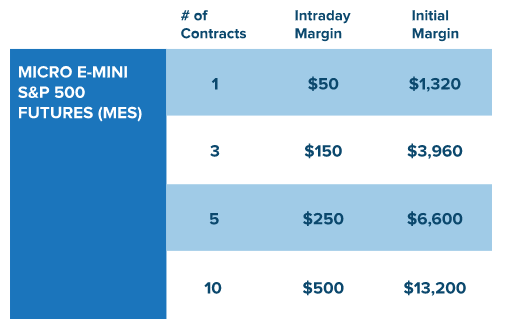
Below is a diagram showing NinjaTrader Brokerage’s intraday and initial margin requirements for Micro E-mini S&P 500 futures (MES). As you can see, based on the escalating margin requirements, it’s extremely important to be aware of the account size needed to hold a position past the market close..
When Are the “Open” and “Close” in 24/6 Futures Markets?
The futures markets trade nearly 24 hours a day, 6 days a week, allowing for more trading flexibility and the freedom to manage positions almost any time of day. However, this can also make it confusing to track the markets’ official “open” and “close."
To avoid accidentally carrying a position past the close, it’s imperative that day traders are aware of a futures contract’s trading hours. For NinjaTrader Brokerage clients, intraday positions must be closed 15 minutes prior to session close. This is 4:45 pm ET for the majority of popular CME Group contracts, which is 15 minutes before the official session close at 5:00 pm ET.
Trading hours for futures contracts are determined by their respective exchanges. Each category, such as energy or equity index, has its own opening and closing times.
- CME Group futures products trading hours
- ICE futures products trading hours
- Eurex futures trading hours
- CBOE futures trading hours
Monitor Margin to Avoid Violations
It's important to remember that margin requirements are the minimum amount needed per contract to maintain a position. While position management is up to the individual trader, it's recommended to give a trade ample breathing room to best avoid margin violations.
- Tip: Use NinjaTrader’s Excess Margin account display to monitor available margin directly through the platform!
Financial leverage can result in losses greater than the initial margin and traders should be aware of the risks involved in trading futures. Risk management policies are strictly enforced and may result in execution fees as well as higher day-trading margins.
Monitor Intraday and Overnight Margins with NinjaTrader
NinjaTrader supports more than 2 million traders worldwide with a powerful and user-friendly trading platform, discount futures brokerage, and world-class support. NinjaTrader is always free for advanced charting and strategy backtesting through an immersive trading simulator.
Download NinjaTrader’s award-winning trading platform and get started with a free trading demo with real-time market data today!