
If you were launching a business, you wouldn't wing it. You'd map out your goals, define your products or services, outline financial expectations, and plan for risk. Futures trading is no different.
Building a trading strategy is about creating a structured plan for how you'll engage with the markets. What will you trade? When will you trade? How will you manage risk? A well-defined strategy can help you stay disciplined, adapt to changing market conditions, and make more objective decisions.
Whether you're new to futures or ready to refine your edge, here's how to think about building a strategy that fits your goals and trading style.
What is a trading strategy?
A trading strategy is a rule-based framework that defines when to enter and exit the market. These rules are typically developed and evaluated using historical market data (i.e., backtesting) and refined over time.
Some strategies are simple—built around one or two technical indicators. Others combine multiple filters, triggers, and risk parameters into a more comprehensive trading system. There's no single "right" level of complexity. What matters is clarity and consistency.
At its core, a strategy can help you remove guesswork. Instead of reacting emotionally to price swings, you're following predefined rules designed to align with your risk tolerance and market outlook.
A clearly defined strategy lays the groundwork for more disciplined decision-making and can help you evaluate performance more objectively over time.
Entry and Exit Rules
Your entry and exit rules form the backbone of any trading strategy. They define exactly when you'll get into a trade and when you'll get out—removing guesswork and helping you stay consistent. Clear, rule-based decisions can help you react to market movement with structure instead of emotion.
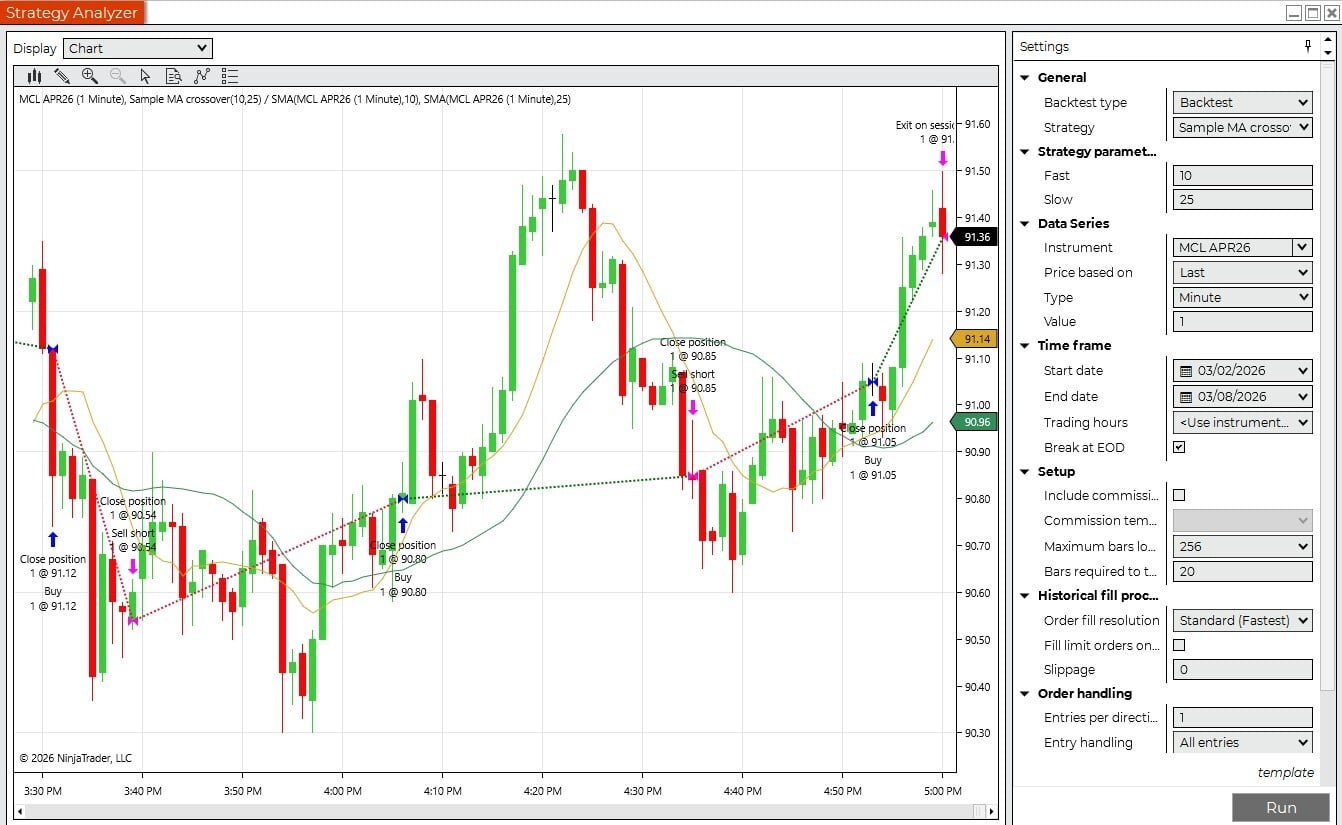
Entry Rules: Filters and Triggers
Every strategy starts with a clear definition of when to enter a trade. Entry rules often rely on technical analysis, price action, or a combination of both. Most entry logic includes two key components:
- Filters: These define the broader market context. For example, a filter might require an uptrend based on a moving average or a minimum level of volatility before trades are considered.
- Triggers: These signal the precise moment to enter. A trigger could be a breakout above resistance, a moving average crossover, or a momentum shift confirmed by an indicator such as RSI.
By separating filters from triggers, you can narrow your focus to potentially higher-probability setups and avoid trading in unfavorable conditions.
Exit Rules: Technical Exits and Money Management
Exits are just as important as entries—if not more. A complete trading strategy defines how and when to close a position, whether the trade is working in your favor or not. Exit rules typically include:
- Technical exits: Based on price action or indicator signals, such as a trend reversal or momentum slowdown.
- Money management rules: These include predefined stop-loss orders, take-profit orders, and trailing stops to help manage risk and lock in gains.
Note that a strategy that uses only technical exits could produce results that have drawdowns exceeding margin limits. This is why money management rules are a necessity for realistic results when testing your strategy.
Clear exit rules can help you manage downside exposure and avoid second-guessing your decisions in fast-moving futures markets.
Together, structured entry and exit rules can help you bring discipline, repeatability, and clearer performance analysis to your futures trading approach.
Learn more in our blog on Mastering Entry and Exit Strategies in Futures Trading.
Account-Level Risk Management
Risk management goes beyond individual trades. Your strategy should also define how much of your account you're willing to risk on each position.
This often includes position sizing rules based on account balance and maximum percentage risk per trade. For example, some traders risk a small, fixed percentage of their account on each trade to help limit drawdowns during losing streaks.
Account-level controls can help you stay in the game longer. By keeping risk consistent, you can create a more stable foundation for evaluating your strategy's performance.
Time-Based Rules and Market Sessions
Futures markets trade nearly 24 hours a day, six days a week. That flexibility opens the door to different approaches—but it also makes timing important.
Some strategies are designed specifically for certain sessions (e.g., U.S. morning hours), days of the week, or high-impact news windows. Time-based rules can also define when positions must be closed, such as before the end of a session.
Aligning your strategy with specific futures trading hours can help you focus on periods that match your lifestyle and preferred volatility levels.
Choosing the Right Market and Timeframe
Not all strategies work across all markets. A setup designed for E-mini S&P 500 (ES) futures may behave differently in crude oil or Micro contracts. Most strategies are built for a:
- A specific futures contract
- A defined timeframe (e.g., 5-minute, 60-minute, daily)
- A directional bias (long-only, short-only, or both)
Instead of chasing a one-size-fits-all solution, focus on developing and testing strategies tailored to a particular symbol and timeframe. This targeted approach can help you better understand how your rules perform under specific conditions.
Read more in our blog on When to Use Different Trading Timeframes.
Backtesting, Optimization, and Forward Testing
Once you've defined your rules, the next step is evaluation. Backtesting allows you to apply your strategy to historical data to see how it would have performed in the past. You can also explore:
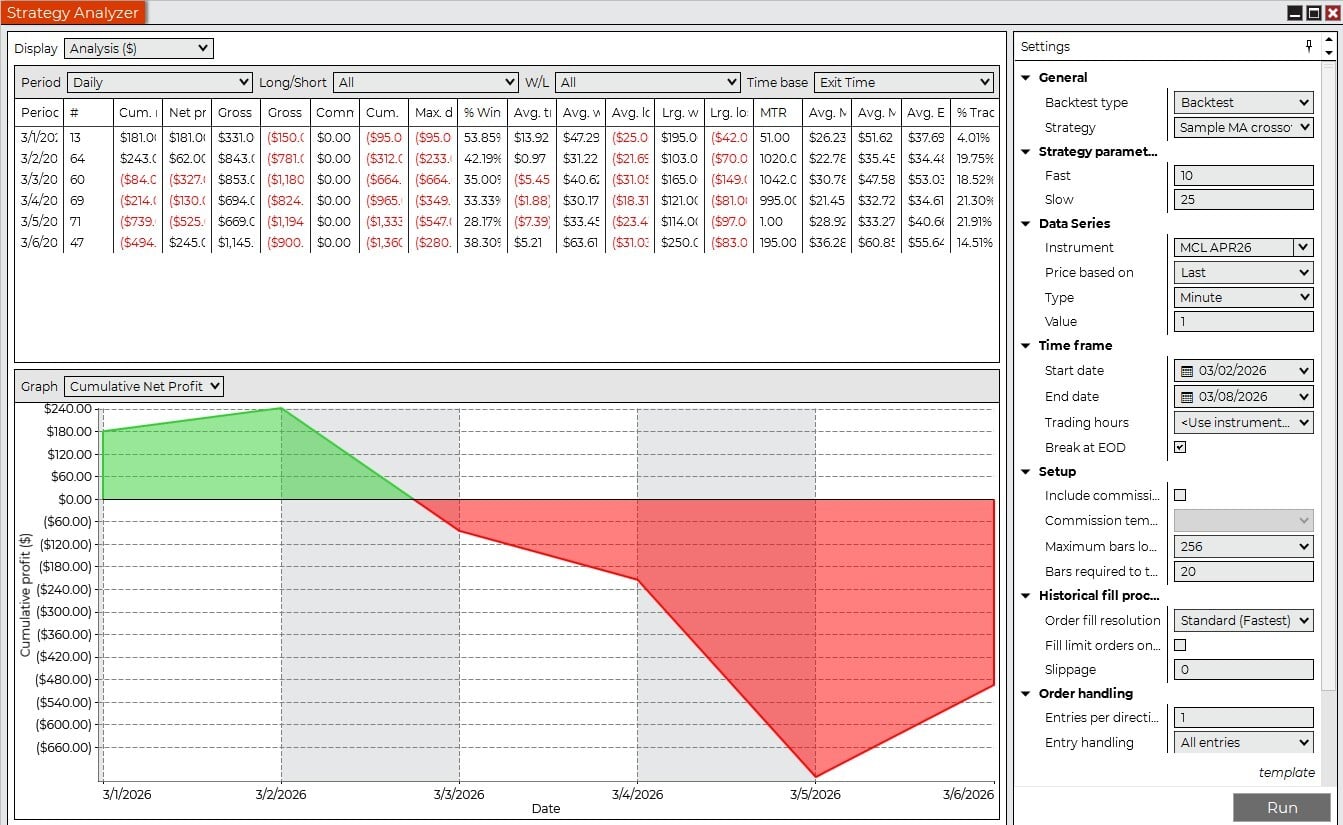
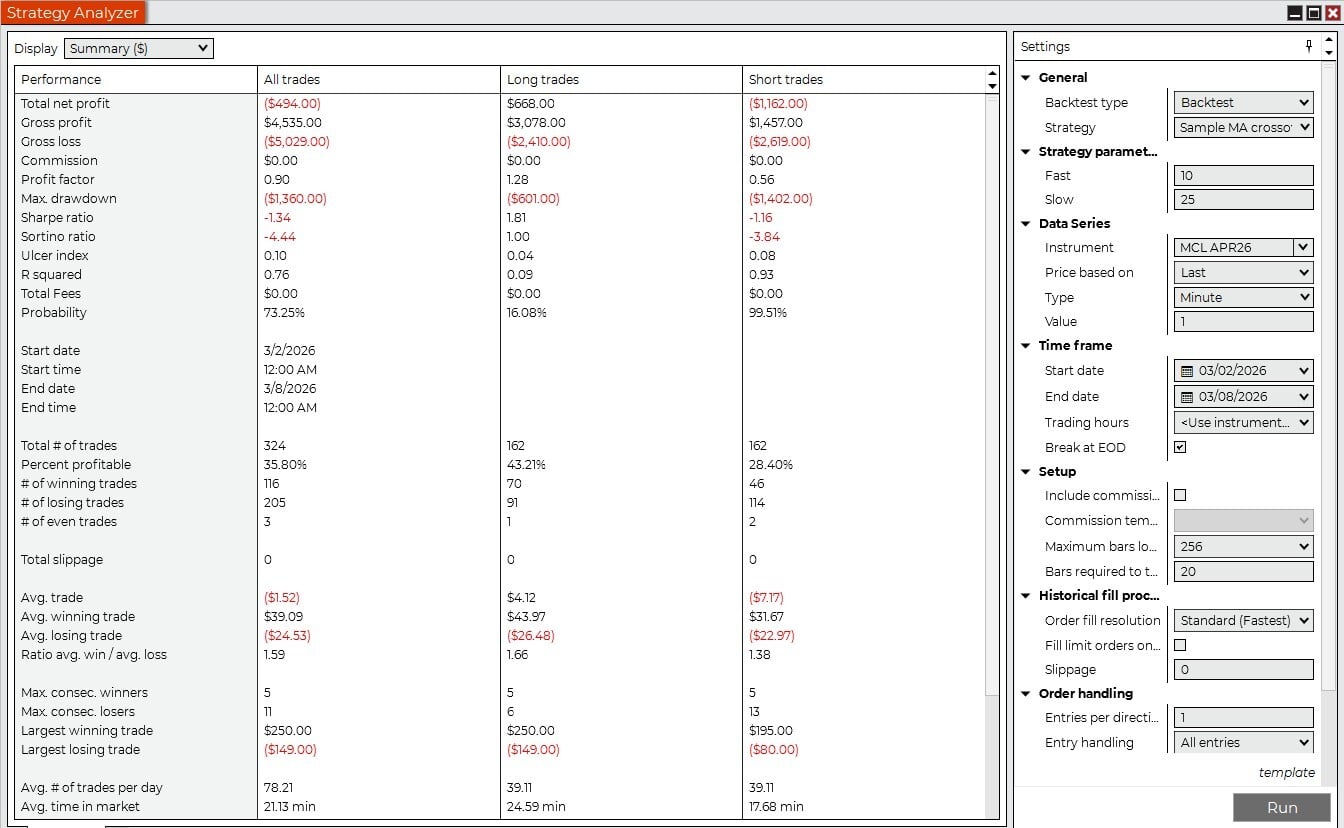
- Optimization: Testing different parameter values (e.g., indicator settings, stop distances) to evaluate how sensitive your strategy is to change.
- Walk-forward testing: Evaluating performance across multiple time segments to help assess robustness.
- Out-of-sample testing: Validating your strategy on data that was not used during development.
Keep in mind that past performance is not indicative of future results. A strategy that performs well in historical testing may behave differently in live markets. Forward testing in a sim environment can help you see how your strategy reacts to real-time conditions before going live.
Automation and Strategy Execution
Once you've built and tested your strategy, you may choose to automate it. Automated trading systems execute trades based on predefined rules without manual intervention.
Automation can help you reduce emotional decision-making and ensure that your rules are applied consistently. Platforms like NinjaTrader support advanced strategy development, backtesting, and automated execution, giving you flexibility to trade your way.
Even if you prefer discretionary trading, clearly defined rules can help bring structure and repeatability to your approach.
Learn more in our blog on Automating Your Trading Strategy With Alerts in NinjaTrader 8.
Continuous Improvement: Adapting to Changing Markets
Markets evolve. Volatility shifts. Price levels change. A strategy that performed well when a contract traded at one price range may require adjustments as conditions shift.
Not every strategy idea will stand the test of time—and that's part of the process. Developing, testing, and refining strategies can help you build experience and uncover insights about how different markets behave.
The goal isn't perfection. It's progress. By staying curious, reviewing your results, and refining your rules, you can continue developing as a futures trader.
Ready to put structure behind your trades? Explore NinjaTrader's powerful charting, backtesting tools, and sim environment to start building and testing your futures trading strategy. Open your NinjaTrader account today to get started.