
Risk disclosure: NinjaTrader Clearing, LLC offers security futures products. Security futures are not suitable for everyone. Losses may exceed the initial investment. Past performance is not necessarily indicative of future results. Promo first used: 07/26/2026. View Risk Disclosure Statement for Security Futures Products.
Simulated trading disclosure: Simulated trading is based on hypothetical results and does not reflect actual trading. Emotional and psychological factors of real money risk are not replicated. Use simulated trading to learn the platform and markets—not as an indicator of live performance.
What are single stock futures?
SSFs work like any futures contract, but the underlying asset is a single stock instead of an index or commodity.
Key facts about single stock futures:
No shares change hands at expiration.
Control more notional exposure than your margin deposit. Leverage amplifies losses as much as gains.
CME-listed contracts cover more than 50 of the largest U.S. equities.
React to earnings and news before or after the equity session.
No borrow fees, no shorting restrictions.
A standard SSF controls 100 shares and a micro controls 10—either one for a fraction of the cost of buying outright.
100 shares per standard contract, 10 per micro. Pick the size that fits the trade.
SSFs behave like the stock—no options formulas or volatility inputs required.
For a side-by-side breakdown, see futures vs. stocks.
SSF trading strategies
Traders use single stock futures for three core strategies: directional speculation on a single name, hedging existing equity positions, and pairs or spread trades between correlated stocks.
| Strategy | Best for | Key risks |
|---|---|---|
| Directional | Traders with a conviction on where a single stock is headed | Leverage amplifies losses; requires disciplined stop-loss placement |
| Hedging | Holders of a concentrated stock position who want to offset downside without selling shares | Imperfect correlation; hedge may not fully offset losses |
| Spread/pairs | Traders seeking relative value between two correlated stocks or an SSF vs. an index | Both legs can move against you; spread may widen unexpectedly |
Directional strategies for trading single stock futures
A directional trade means taking a long or short SSF position based on where you think a stock is headed. No Greeks, no formulas—just the stock you follow, futures-style.
Going long
Buy an SSF contract when you expect the underlying stock to rise. Your P&L is based on the difference between entry price and settlement price at expiration.
Best for: Traders with a bullish thesis on a specific name who want leverage without buying shares outright.
Going short
Sell an SSF contract when you expect the stock to fall. Unlike shorting stocks, there are no borrow fees and no hard-to-borrow restrictions.
Best for: Traders with a bearish thesis who want to capture downside without the friction of short selling.
Trend-following
Identify a stock in a sustained move and enter in the direction of that trend. Use technical levels to time entries and set stops.
Tools: NinjaTrader's advanced charting and Order Flow+ help identify key support, resistance, and volume-at-price levels on individual stocks.
Breakout and pullback entries around catalysts
News hits before the bell. So can you. Earnings reports and macro announcements create high-conviction setups. Because SSFs trade 23/5, you can position before a catalyst or react the moment news breaks—not at the next equity open.
Breakout: Enter on a surge through key resistance. Pullback: Wait for price to revisit support after the initial move.
Before placing your first directional SSF trade, review our guide to margin and leverage in futures markets.
Hedging existing stock positions with SSFs
Hedging with single stock futures means taking a short SSF position against a long stock position to offset downside risk. Long or short, the trade is yours.
This can be useful if you hold a concentrated equity position and want downside protection without selling your shares.
Single-name hedge
Short one SSF contract against a long stock position. If the stock falls, the SSF gains value and offsets some or all of the loss on your equity holding.
The degree of protection depends on the SSF contract's notional size relative to your position. Because standard and micro contracts can be mixed, a hedge can be sized in 10-share increments rather than 100—useful when the holding isn't a round multiple of 100 shares.
Sector or basket hedge
Hold positions across several stocks in the same sector? Short SSFs on the most liquid or correlated names to hedge broader exposure.
Less precise than a single-name hedge but faster to implement and more capital-efficient than buying puts.
For more on managing risk across a futures strategy, see NinjaTrader's risk management for futures trading.
Spread and pairs strategies with single stock futures
A spread strategy means taking offsetting long and short SSF positions in two related contracts. You profit from the change in their price relationship, not the direction of either leg alone.
Contract size affects both legs. Standard and micro contracts can be combined on either side, which brings two legs closer in notional than whole standard contracts allow—useful when the two stocks trade at very different prices. Both legs remain leveraged, and leverage amplifies losses as much as gains.
Long/short pairs between competitors
Go long an SSF on the stock you expect to outperform; short an SSF on the one you expect to underperform. Classic examples: AAPL vs. MSFT, AMD vs. INTC.
Because both legs are SSFs, you avoid borrow fees on the short side and get capital efficiency on both legs.
Single-name vs. index spread
Go long (or short) an SSF on a specific stock while taking the opposite position in a related index futures contract—for example, NQ vs. NVDA.
This expresses a view that the individual stock will outperform or underperform the broader index. See how futures fit into a broader trading strategy for context on building multi-leg approaches.
NinjaTrader supports single stock futures (SSF) trading with advanced charting, advanced trade management (ATM) order automation, and a simulated trading environment for strategy testing before going live.
Risk management for SSF traders
Because single stock futures are leveraged and financially settled at expiration, position sizing and stop-loss discipline are essential. NinjaTrader's risk tools let traders set automatic stops, targets, and daily loss limits.
Position sizing
A standard SSF contract controls 100 shares; a micro controls 10. At a $200 stock price, that's $20,000 in notional exposure for the standard contract and $2,000 for the micro. Margin is set as a percentage of notional, so it scales the same way—but a smaller requirement means smaller exposure, not less risk per dollar committed. Mixing the two sizes also lets you size in 10-share increments rather than 100. Size positions relative to your account equity and the stock's volatility—not just the margin requirement.
Many traders cap per-trade risk at 1–2% of account equity.
Standard and micro contract sizes
The two contract sizes are the same instrument at different scale. A standard contract represents 100 shares of the underlying stock; a micro represents 10. Trading hours, settlement, and the expiration cycle are identical, and margin is the same percentage of notional for both. What changes is the size of the position and the increment you can size it in. Not every name lists in both sizes.
That pairing is standard practice in futures. Micro futures contracts exist across the market for the same reason, so traders can scale a position without changing instruments. For full contract specifications and the current list of names, see our guide to single stock futures contracts.
| Standard contract | Micro contract | |
|---|---|---|
| Shares per contract | 100 | 10 |
| Notional value | 100 × the futures price | 10 × the futures price |
| Tick size and tick value | $0.01 per share, or $1.00 per contract | $0.01 per share, or $0.10 per contract |
Stop-loss placement
Set stops at technically meaningful levels, not arbitrary dollar amounts. This can help you avoid being stopped out by normal volatility while still capping losses on sustained adverse moves. Stops may fill at a worse price during gaps, news events, or thin liquidity.
With SSFs trading 23/5, you can respond to after-hours news rather than waiting for the opening bell.
Advanced trade management (ATM) strategies
NinjaTrader's ATM strategies automate stop-loss, take-profit, and trailing stop orders the moment a position is entered. Save and apply them consistently across trades for disciplined, systematic risk management.
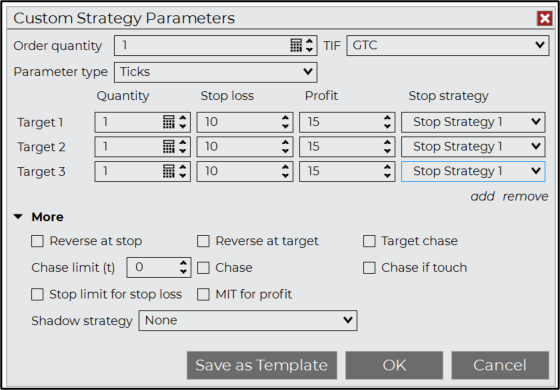
Test your setups before going live: NinjaTrader's simulated trading environment lets you trade SSFs in sim with no financial risk—including at the contract size you intend to trade live, so the sizing is part of the test.
For a full framework, see our guide to developing a futures trading plan.
How NinjaTrader supports single stock futures trading
The stocks you know. The futures edge you want. NinjaTrader gives you everything you need to trade SSFs—from research and strategy testing to live execution and risk management.
Real-time data on SSF and underlying stock price action
Volume-at-price analysis to identify key levels on individual stocks
Automated stop-loss, take-profit, and trailing stop orders
Test SSF strategies with no financial risk before going live
Monitor and manage positions wherever you are

FAQs on single stock futures trading strategies
What strategies work best for trading single stock futures?
The three most common approaches are directional trades (long or short based on a price view), hedging (shorting an SSF against a long stock position to offset downside), and spread or pairs trading (offsetting SSF positions in correlated stocks or an SSF vs. an index). The right strategy depends on your market thesis, risk tolerance, and capital.
Can I hedge a stock position with single stock futures?
Yes. A short SSF on the same stock you hold long is one of the most direct hedging tools available. If the stock falls, the short SSF gains value and offsets some or all of your equity loss. The degree of protection depends on the contract's notional size relative to your holding. Because standard and micro contracts can be mixed, a hedge can be sized in 10-share increments rather than 100—useful when the holding isn't a round multiple of 100 shares.
How is a single stock future different from a stock?
A stock represents ownership in a company. An SSF is a contract to exchange the cash value of that stock at a future date—no ownership involved. Because it's leveraged, a standard SSF gives you exposure to 100 shares of the underlying—or 10 shares with a micro contract—while tying up only margin instead of the full purchase price, far less capital than buying those shares outright. That efficiency cuts both ways: leverage magnifies losses as much as gains, the position must maintain margin, and unlike shares, the contract expires. SSFs are also financially settled at expiration and allow short selling without borrow fees or restrictions.
What CME single stock futures are available on NinjaTrader?
CME-listed SSFs currently cover more than 50 of the largest U.S. equities, including names like Amazon, Apple, Meta, Nvidia, and Tesla. The full list of available contracts is available through the NinjaTrader platform or at the CME Group website.
How do I test an SSF strategy before trading live?
NinjaTrader's simulated trading environment lets you trade SSFs using real market data with no financial risk. It's the fastest way to get comfortable with how SSFs behave around earnings and catalysts before committing capital. Access sim through your free NinjaTrader account.
What does “financially settled” mean for SSFs?
Financially settled means no shares change hands at expiration. Your profit or loss is calculated as the difference between your entry price and the final settlement price, paid in cash. You never need to own or deliver the underlying stock.
When does micro size matter for a strategy?
Whenever the position you want doesn't land on a round multiple of 100 shares. A micro represents 10 shares of the underlying against 100 for a standard contract, so you can build, trim, and hedge in 10-share increments. That matters most when matching a hedge to a holding that isn't a round lot, or bringing two legs of a pairs trade closer in notional.
How do standard and micro contracts change how a strategy is sized?
They change the increment, not the strategy. A directional position can be built in 10-share steps rather than 100. A single-name hedge can be matched more closely to a holding that isn't a round multiple of 100 shares. A pairs trade can bring two legs closer in notional by mixing sizes on either side. The mechanics of each strategy are the same at both sizes, and so is the leverage—smaller notional means smaller exposure, not less risk per dollar committed.