
Three structural advantages to trading futures
Why trade futures? Three structural advantages: leverage, deep liquidity, and tax treatment. Futures contracts let traders control a large notional position with a small capital deposit (often less than 5% of contract value), trade in markets that are deeply liquid nearly 24 hours a day, and receive blended long-term/short-term capital gains treatment under Internal Revenue Code (IRC) §1256 regardless of holding period. These three advantages (leverage, liquidity, and taxes) are structural features of the futures market itself, not platform-specific perks.
New to the mechanics of getting started? Our how to trade futures step-by-step guide walks you through it.
Futures contracts are standardized agreements traded on regulated exchanges (CME Group, ICE, CBOE) that obligate the buyer and seller to transact a specific asset (an equity index like the S&P 500 Index, a commodity like crude oil or gold, a foreign currency, or a U.S. Treasury bond) at a predetermined price on a future date. NinjaTrader provides direct market access to the full CME Group product suite, including the E-mini S&P 500 (ES) and other E-mini and Micro E-mini equity index futures (NQ, RTY, YM and their micro counterparts), energy futures (crude oil, natural gas), metals (gold, silver), interest rate futures, and FX futures, with order types and execution speed designed for active day traders.
Together, leverage, liquidity, and favorable tax treatment are what draw many active traders to the futures markets in the first place.
The Benefits of futures trading
Futures give active traders advantages that other markets can’t always match. If you’re just getting oriented, start with our futures trading basics overview, then explore the specific benefits below.

No shorting restrictions or day trading rules
For futures traders, entering a short position is seamless and every future can be shorted, for any number of contracts and at any time. With other asset classes, traders are often limited by the inability to easily go short to take advantage of a downward trending market. In addition, unlike stocks, which require traders to have a minimum account balance of $25,000 to make more than just a few day trades per week, futures do not have a pattern day trader rule.

Flexible trade sizing
Traders at all levels—from beginners to pros—can easily participate in the futures markets due to the choice of contract sizes to trade. Micro futures (1/10th the size of a standard E-mini futures contract) allow new futures traders to get started with less capital and the potential to reduce risk. This flexible trade sizing provides more control over exposure to the market and the ability to easily scale in and out of multi-contract positions. Additionally, Micro futures offer the same price discovery and liquidity as their standard-sized counterparts.

Increased leverage
The leverage available through futures allows you to control a larger trading position with less capital (e.g., a smaller account size). With futures, you can often put up less than 5% of the contract value to control a position. A note of caution: while the opportunity for potentially greater profits exists, so does the increased risk of greater losses. When trading leveraged futures, make sure you have a risk management plan in place, including the appropriate trade sizing, and are only risking a small amount of capital on any one trade.

Virtual 24-hour trading
Trading opportunities can happen at any time—especially in a global marketplace—and often occur while the stock market is closed. Futures markets are open nearly 24 hours a day, six days a week. While some other asset classes may offer similar trading hours, futures are recognized for usually having higher levels of liquidity throughout trading hours due to their global market participation. This elevated trading volume makes entering and exiting positions easier and delivers tighter bid/ask spreads.

Diverse and uncorrelated markets
Futures provide access to diverse markets that drive the international economy including major market stock indexes, bonds and foreign currencies, as well as vital commodities like gold, crude oil, coffee, and many others that may otherwise be difficult or impossible to trade. Many of these markets are uncorrelated and can offer greater price trend diversification than other types of highly correlated investments like stocks and forex. This diversification also allows futures traders to take advantage of more unique trading situations and opportunities.

Fair and transparent price discovery
Although often assumed by traders, a transparent marketplace is not a given for all asset classes. With futures, it’s just you against the market. All futures traders see the same prices and have the same opportunity to place orders and get them filled. In addition, volume data for all orders and transactions is visible in real time. There is no insider or dark pool trading, and regardless of account size, all market participants trade on a level playing field.

Tax Advantages
Under Internal Revenue Code Section 1256, futures trading gains are split between long-term capital gains and short-term gains. This is a tax advantage for futures traders over short-term stock trading. In essence, 60% of futures trading gains are taxed as long-term gains regardless of the holding period, and the balance of 40% is taxed as short-term gains. Keep in mind tax laws and capital gains tax rates are subject to change overtime. Always check with a tax advisor or accountant regarding your situation.

Mature and regulated industry
Futures trading and exchanges are highly regulated by the Commodities Futures Trading Commission (CFTC) and serve an important price hedging role for all types of industries. Futures exchanges, such as CME Group, serve as the clearinghouse for all trades, set the rules for margin and contract specifications, and match and guarantee all transactions whether cash settled or physically delivered. Additionally, futures commission merchants (FCMs) are required to maintain all customer funds in a segregated account to ensure the protection of customer assets.

Deep liquidity from global market participation
Futures markets pool buy and sell interest from institutional desks, commercial hedgers, proprietary trading firms, and retail traders into a single centralized order book at each exchange. For the most liquid contracts—the E-mini S&P 500, the 10-Year Treasury note (ZN), and crude oil (CL)—this concentration produces tight bid-ask spreads (often one tick), deep order book size at the top-of-book, and the ability to enter and exit large positions with minimal slippage. Centralization at the exchange (CME Group venues for most contracts) means traders see the same prices and the same depth, with no fragmentation across dark pools or alternative venues the way equity order flow is split.
Because all that depth sits in one transparent book, you can read it directly: learn more about order flow trading with NinjaTrader Order Flow+.

Develop The Trader In You
Get started on your futures trading journey with our exclusive video series. Watch an introduction to the basics along with actionable take aways to help you learn how to trade futures.
See why day traders are adding futures to their trading portfolios
Whether you are a new trader or a seasoned veteran, you want to participate in a marketplace that provides a level playing field, substantial opportunity potential, and the widest variety of diverse uncorrelated markets to trade. Futures trading provides all this and much more, and we’ve made it easy to compare. See how futures trading measures up to other asset classes.

Futures vs. Stocks
Key advantages of trading futures over stocks include increased leverage, 24-hour trading, unrestricted shorting, tax advantages and trading on a level playing field just to name a few.

Futures Vs. Forex and CFDs
Forex and CFD traders are discovering forex futures present a more efficient and effective trading choice featuring a well-regulated marketplace, transparent pricing and volume, and trading on a level playing field.

Futures vs. Cryptocurrencies
Futures offer a more secure and flexible trading option than cryptocurrencies starting with a highly regulated trading environment where the safety of funds is paramount and transactions are guaranteed by exchanges.

Futures vs. Stock Options
Compared to trading stock options, futures offer a straight-forward and transparent trading experience. To start, there only two trading options: buy and sell. This allows you to go long or short as needed.

Global futures markets at your finger tips
Futures products span the globe across index futures, currency futures and leading commodities. Explore the various futures contracts available to trade nearly around the clock including:
Experience the benefits of futures trading with NinjaTrader
Unlimited risk-free simulated trading is included with all accounts. When you’re ready for live trading, get started with Micro futures contracts to access the popular index futures markets with reduced costs, including only $50 margins.
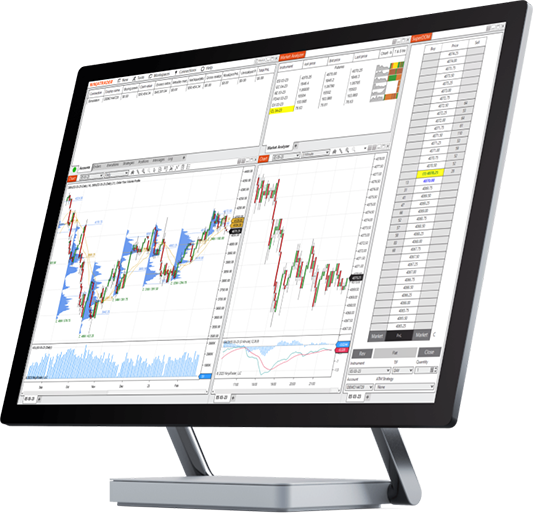
Additional Tools And Services To Support Your Futures Trading Include:
- Unlimited simulated futures trading
- Unfiltered professional market data
- Extensive historical tick, min and daily data
- Free 24-hour emergency help desk
- Award-winning charting and analysis
- 100+ technical indicators
- 1,000s of third-party trading apps
- Unlimited support and daily training