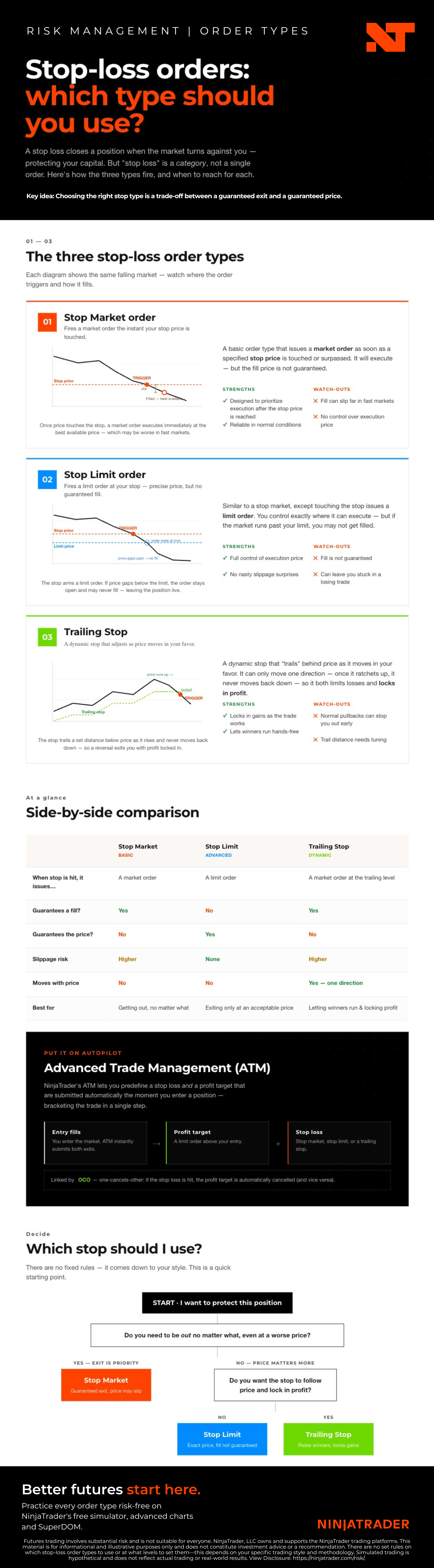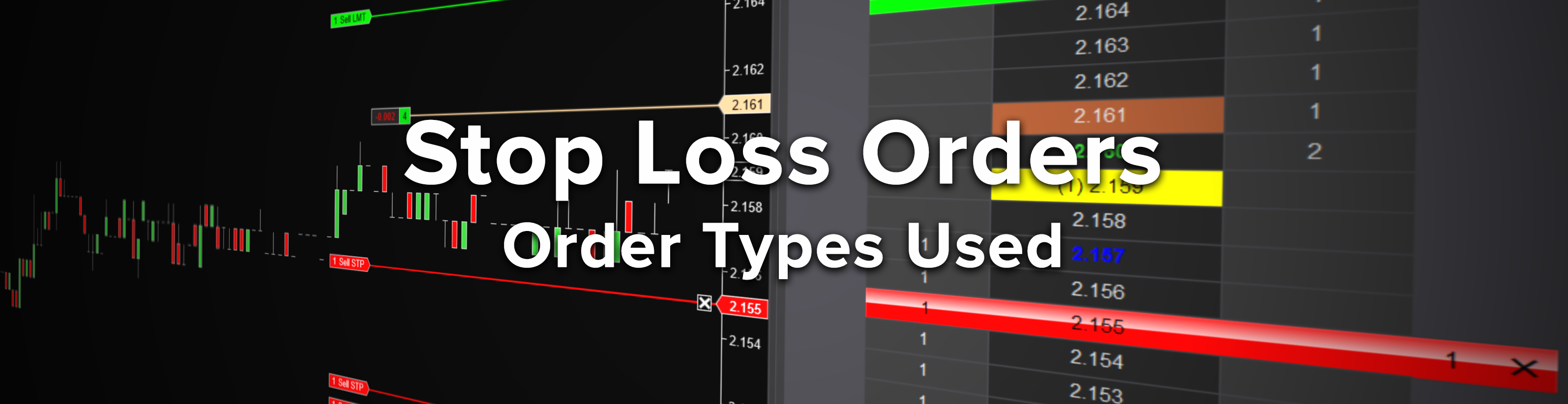
A stop-loss order is a conditional order type used in futures trading to exit a position automatically when price reaches a defined level. There are three main stop-loss order types available to futures traders: the stop market order, which guarantees an exit but not the execution price; the stop limit order, which gives price control but does not guarantee a fill; and the trailing stop, which adjusts dynamically as price moves in your favor.
The right type depends on your trading style, the market's current volatility, and whether execution certainty or price certainty matters more in a given trade. Understanding the differences between these order types is a foundation of effective risk management for futures trading. Whether you're refining an existing strategy or placing your first stop, the order type you choose shapes both your risk exposure and your likelihood of getting filled.
This guide breaks down how each type works and when to use each. If you're newer to order mechanics, our guide to the basic order types explained is a useful starting point.
Stop market orders: guaranteed exit, variable price
When you use a stop order in futures trading, you're instructing the platform: if price hits my level, get me out immediately. A stop market order does exactly this—it converts to a market order the moment price touches or passes through your stop price, filling at the best available price in the market.
The primary benefit is execution certainty: you will exit the position. The tradeoff is price certainty: your fill may differ from your stop price, particularly in fast-moving conditions. That difference is called slippage, and it's the main risk to account for with stop market orders.
When stop market orders make sense
Stop market orders are the default choice when getting out matters more than the exact exit price. Common scenarios include:
- Economic data releases or news-driven events that can cause rapid, gapping price movement
- Overnight or thinly traded sessions where spreads are wider and price gaps are more common
- Any situation where an unfilled stop would be worse than a slightly worse fill price
The risk of slippage
In liquid futures markets—such as E-mini S&P 500 or crude oil—slippage is typically minimal under normal conditions. In less actively traded contracts or during extreme volatility, it can be more significant. Stop market orders also carry gap risk: if the market opens well beyond your stop level, your fill price may differ substantially from your stop price.
Use a stop market order when execution certainty outweighs price precision—just go in aware of slippage risk.
Stop limit orders: price control without a guaranteed fill
A stop limit order adds a second price to the equation. You set a stop price (the trigger) and a limit price (the floor for your exit). When price hits your stop trigger, a limit order is placed at your specified price rather than a market order.
This gives you control over the worst-case exit price. The tradeoff: If price moves quickly and gaps past your limit, the order may not fill at all, leaving you in the position with an open loss.
How stop limit orders work in practice
Say you're long a futures contract and you set a stop limit order with a stop price of 4,500 and a limit price of 4,498. When price drops to 4,500, a sell limit order at 4,498 or better is placed. If the market drops straight to 4,495 without trading at 4,498 or above, that limit order won't fill. You remain in the position.
When stop limit orders make sense
Stop limit orders are best suited for conditions where they're unlikely to go unfilled:
- Range-bound markets where price movement is predictable and large gaps are uncommon
- When you have a clearly definedmaximumacceptable exit price and can accept the risk of no fill
- Traders who need price discipline over execution certainty in their strategy
Stop limit orders give you control over your exit price but introduce the risk of going unfilled—a tradeoff that demands careful consideration based on market conditions.
Trailing stops: A price-following exit to manage risk on open trades
A trailing stop is a stop-loss that moves with price as a trade moves in your favor but never adjusts in the opposite direction. If you're long and price rises, your stop moves up; if price reverses, the stop holds its level and triggers if hit. For a step-by-step setup walkthrough, see how to set a trailing stop-loss.
Trailing stops are most effective when you want to protect gains without committing to a fixed exit price. They let winning trades run while maintaining a defined exit if the market reverses.
Trailing stop mechanics
The trailing increment—how far the stop trails behind price—is the key variable you control. A tight trailing stop protects more profit but may trigger on normal intraday price fluctuations. A wider trailing stop gives the trade more room but risks giving back a larger portion of your gain before the stop fires.
Best conditions for trailing stops
Trailing stops are well suited for:
- Trending markets where price is moving consistently in one direction
- Strategies that prioritize letting winners run without requiring active stop management
- Scenarios where you want dynamic risk adjustment as the trade moves in your favor
Trailing stops sit at the intersection of profit protection and flexibility—they're purpose-built for trend-following strategies where letting winners run is part of the plan.
Stop market vs. stop limit: how to decide which one to use
Choosing between a stop market and a stop limit order comes down to one question: what matters more in this trade—getting out for certain, or getting out at a specific price? The table below captures the key differences:
| Stop market order | Stop limit order | Trailing stop |
Execution guaranteed? | Yes—fills at best available price | No—may not fill if price gaps through limit | Yes (default) / No (if stop limit used) |
Price certainty? | No—slippage possible in volatile markets | Yes—won't execute past the limit price | Adjustable via trailing offset |
Best suited for | High-volatility markets; ensuring an exit above all else | Range-bound markets; precise exit levels | Letting winning trades run while protecting gains |
Key risk | Slippage and gapping in fast markets | Order goes unfilled if market gaps through limit | May be triggered by normal intraday volatility |
Supported in NinjaTraderATM? | Yes | Yes | Yes, via Auto Trail |
Here are the conditions that should guide your decision:
- Use a stop market orderwhenyou'rein a volatile market, near a major news event, or in a thinly tradedsessionand youcan'tafford to miss your exit. Slippage is preferable tonofill at all.
- Use a stop limit orderwhenyou'rein a stable, range-bound market with enough liquidity that price is unlikely to gap past your limit. You need price control and can accept the risk of a missed fill.
- Use a trailing stopwhenyou'rein a profitable trade and want to capture as much of the move as possible without actively managing your stop.
The right choice depends on your strategy, the market you're trading, and current volatility. Knowing all three types is a core part of mastering entry and exit strategies in futures trading.
No single stop-loss type is best in all situations—knowing when each one serves you is what separates reactive trading from structured risk management.
How to set stop-loss orders in NinjaTrader
NinjaTrader supports all three stop-loss order types, and each can be configured directly from the platform's trading interfaces. For a step-by-step order entry walkthrough, see how to place a futures order.
Using ATM strategies for automated stop-loss management
NinjaTrader's ATM (advanced trade management) lets traders predefine a stop-loss and profit target before entering a position, automatically submitting both orders on fill and linking them via OCO (one-cancels-other) so that if one order is triggered, the other is cancelled.
When configuring an ATM strategy, traders choose whether the stop-loss is submitted as a stop market order or a stop limit order—a setting that directly affects executioncertainty. NinjaTrader also supports trailing stops within ATM strategies through the Auto Trail feature, which automatically moves a stop order by a defined increment as the trade moves favorably.
For a full walkthrough, see how to use ATM strategies on NinjaTrader.
Choosing the right stop order type in your ATM setup
When building an ATM strategy, your stop order type selection has real consequences. A stop market ensures your position exits on a move against you but leaves you exposed to slippage. A stop limit within ATM gives you price control but opens the door to an unfilled stop during a fast market.
Many futures traders use stop market orders in their ATM configurations, but understanding the distinction matters before you commit to a strategy.
NinjaTrader's ATM strategies make it easy to preconfigure stop-loss logic, so your risk parameters are set before you enter a trade, regardless of which stop type you choose.
FAQs about stop-loss orders in futures trading
What’s the difference between a stop market and stop limit order?
A stop market order triggers a market order when price hits the stop price; execution is guaranteed at the best available price, but that price may be worse than expected in a fast-moving market. A stop limit order triggers a limit order at the stop price, giving you a price floor (or ceiling) for execution.
The tradeoff: a stop limit order may not fill at all if price moves quickly through the limit level. In volatile conditions, that can mean staying in a losing position longer than intended.
What happens if price gaps through my stop limit order?
If the market gaps past your stop price and the current price is beyond your limit price, a stop limit order will not execute. This is the primary risk of stop limit orders around economic data releases, overnight opens, and other high-volatility periods.
In those conditions, a stop market order offers more reliable exit protection at the cost of potential slippage.
When should I use a trailing stop instead of a fixed stop-loss?
A trailing stop is most useful when you're in a profitable trade and want to protect gains without exiting too early. Unlike a fixed stop, a trailing stop moves in the direction of your position as the market moves favorably, but it does not move back if the market reverses.
It's best suited for trend-following strategies where letting winners run is part of the plan.
Can I automate stop-loss order placement in NinjaTrader?
Yes. NinjaTrader's ATM (advanced trade management) functionality allows traders to predefine stop-loss orders and profit targets that are automatically submitted when a position is opened. Within ATM settings, you choose the stop order type—stop market, stop limit, or trailing stop via Auto Trail—so your risk parameters are set before you enter the trade.
Does slippage affect stop-loss orders in futures trading?
Slippage is primarily a risk with stop market orders in fast-moving or thinly traded markets, where the best available price at execution may be meaningfully worse than the stop price. Stop limit orders avoid this risk by capping the execution price, but introduce the risk of no fill.
Liquid futures contracts, like E-mini S&P 500 or crude oil futures, generally have tighter slippage than less actively traded contracts.